Same model, two harnesses, 17 points apart: what an agent harness actually changes
Mistral Large 4 scored 41.4% in one coding agent and 24.7% in another. The weights were identical. The difference was everything around them.
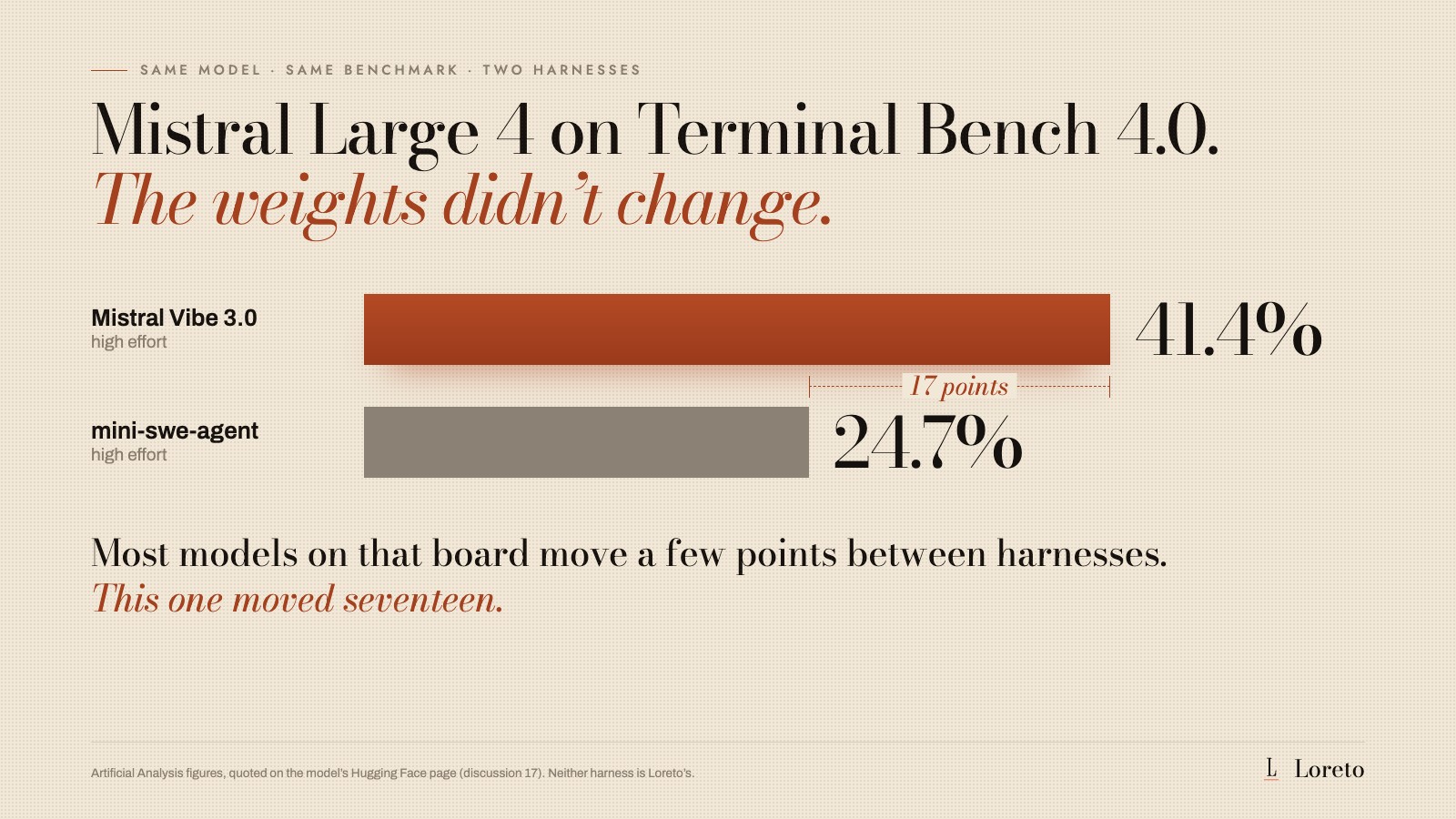
A harness is everything around the model: its settings, the instructions it reads, the limits on its loop and the checks it must pass before it can finish. The same open model can score very differently in two harnesses; Mistral Large 4 moved 17 points on Terminal Bench 4.0. Tuning a harness to one model means fixing its reasoning and sa…
Most arguments about open models in coding agents are about the weights. Which size, which quant, whether it is close enough to the frontier. Here is a number that should change where you look first.
On Terminal Bench 4.0, Mistral Large 4 scored 41.4% running in Mistral Vibe 3.0 at high effort, and 24.7% in mini-swe-agent at the same effort. Same weights, same tasks, seventeen points apart. Most models on that board move a few points between harnesses, so this is not noise. (Artificial Analysis figures, quoted by a user in a thread on the model's Hugging Face page. Neither harness is ours.)
If seventeen points can live outside the model, it is worth knowing exactly what lives there.
What a harness is
The harness is everything between you and the weights: the settings the agent sends with each request, the instructions it reads at the start of a session, the limits on its loop, and the checks it has to pass before it is allowed to say it is finished. Claude Code, OpenCode, Codex and Hermes are harnesses. So is your config for them.
Frontier models are trained and tested against a few well known harnesses, so the defaults mostly fit. Open models are not. They arrive with a chat template, a recommended sampling setup buried in a model card, and a set of habits nobody has written down yet. The agent does not know any of that.
Five things that change per model
1. Reasoning and sampling
Whether reasoning is on, which effort levels the template accepts, temperature, top_p, top_k. These are different for every model, and the agent's defaults are usually someone else's. One model in our catalogue only accepts low, medium and xhigh; pick the agent's high and every request fails. For Mistral Large 4, the harness defaults effort to high, because that is the setting the 41.4% was measured at.
2. Loop limits
Open models fail in agents by spinning far more often than by being wrong. Block the third identical read or search. Cap the steps, and tell the model to answer with what it has when it gets close to the cap. A run that stops with a partial answer beats one that burns an hour and returns nothing.
3. A gate on "done"
Do not accept "done" on the model's word. Make the agent run checks you already have (it parses, types check, tests pass) and show the output before it can finish. This is the cheapest single change, and it catches the most expensive failure: a confident summary on top of code that does not build.
4. The model's own known problems, written down
Not generic "be careful" rules. The specific thing this model is reported to do, with the fix, in the file the agent reads every session. If a model is known to re-check a plan it already has, the instruction is "check a plan once, then make the first edit", not "think efficiently".
5. Serving settings the agent cannot reach
Some fixes live on the server, not in the agent: a hard thinking budget, the right tool call parser, a patched chat template. The agent cannot set them, so the harness has to tell you how, for the server you actually run.
What it does not do
None of this makes a mid sized open model match a frontier model on hard problems, and anyone claiming that is selling something. The outcome is narrower and more useful: fewer runs that spin forever, fewer "done" messages on broken code, less time reading a diff to find the model quietly gave up halfway. For everyday work that is the difference between babysitting an agent and using one.
Try it on your model
We write a free harness for each of 69 open models in Claude Code, OpenCode, Codex, Hermes and DeepSeek's harness. Each ships a known issues file that links every public report it answers, so you can check our reading of them. The Mistral Large 4 harness is one of them. Install any of them with one line:
npx loreto add mistral-large-4 --agent opencodeOr read every file first on the model's page. We have not benchmarked these harnesses yet, so treat them as fixes for reported problems, not a score.
Frequently asked questions
Is the 17 point gap a Loreto result?
Does a better harness make an open model as good as a frontier model?
Which of the five changes should I make first?
Then tune it to your repository
The free harness fixes what the model gets wrong everywhere. Paste a repository and see what your own history adds: reverts, files that move together, code to reuse.