What did the robot that beat Usain Bolt forget to learn?
How to stop. Eight point six four seconds over a hundred metres — and then a padded blue wall.
Deceleration. At the 2026 World Humanoid Robot Games in Beijing, X-Humanoid's Tiangong Ultra ran 100 metres in 8.64 seconds — faster than Usain Bolt's 9.58 — and then slammed into the padded wall at the end of the track. The sprint was scored, so it got optimised. Stopping was not scored, so nobody wrote it down. That is the same gap tha…
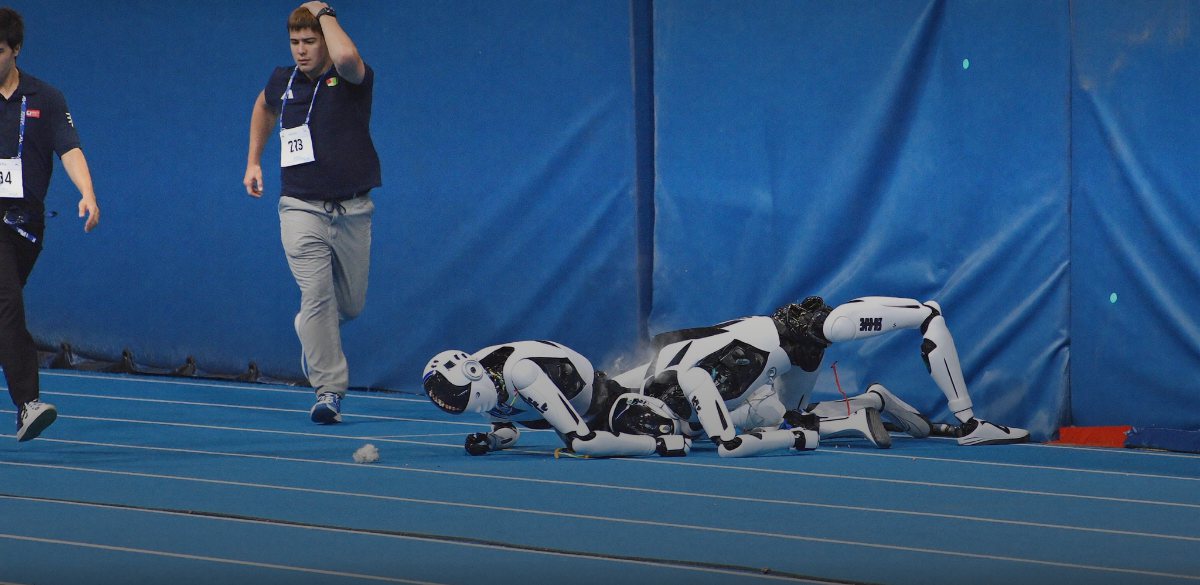
Two competitors at the end of a sprint. Both cleared a hundred metres. Neither had a procedure for what comes after one hundred metres.
In August 2026, at the World Humanoid Robot Games in Beijing, a machine called Tiangong Ultra ran a hundred metres in 8.64 seconds. Usain Bolt's world record is 9.58. Its builder, X-Humanoid, broke the robot record three times in five days: 9.39, then 8.86, then 8.64. The previous year's winning time was 21.50 seconds.
Two and a half times faster in twelve months. It is a genuinely extraordinary number, and almost nobody remembers it, because of what happened next.
It hit the wall. A padded blue wall at the end of the track, there because the organisers already knew.
The sprint was scored. The stop was not.
This is not a story about robots being bad. It is a story about what gets built.
There was a leaderboard for the hundred metres. There was a clock, a record, and a headline waiting for whoever beat it. Every hour of engineering effort had a visible payoff, so the sprint got extraordinary attention and improved at a rate that would be implausible in any human sport.
Deceleration had no leaderboard. No clock, no record, no headline. So it did not get written down — not because the engineers were careless, but because the benchmark defined what counted as the job, and stopping was outside it.
The event ran 51 competitions across 1,301 contests, with 2,056 robots from 666 teams. The organisers had also started pushing the programme toward warehousing, assembly and emergency response — which is a quiet admission that a sprint record is not the thing anybody actually needs.
Efficacy is not effectiveness
The distinction is old and worth borrowing exactly. Efficacy is performance under ideal conditions: the clean track, the known distance, the run that was practised. Effectiveness is performance in the world, where the distance is not known in advance and there is something at the end of it.
Every enterprise AI programme meets this, usually about six weeks after a very good demo. The demo is the sprint: a chosen document, a clean input, a person who knows what the answer should be. Then it goes into production, and the input arrives malformed, or the source system is down, or the case is one of the fifteen percent nobody mentioned, and the system runs full speed into a wall it was never told existed.
The pattern is identical:
- The measured part gets optimised, hard.
- The unmeasured part gets skipped, silently.
- The unmeasured part is where all the failures live.
What a skill actually covers
A skill is a written procedure, and the reason it earns its keep is that the useful half is always the unglamorous half. Not “how to review the document” — any capable model can improvise that. But:
- What to do when a required field is missing.
- When to stop and escalate rather than proceed on an assumption.
- What the handoff looks like, and what has to be attached to it.
- How to undo the thing if it turns out to be wrong.
None of that shows up in a demo. All of it shows up in month three. A procedure that only describes the sprint is not a procedure; it is a highlight reel.
The same word is now appearing in robotics
The convergence here is not a metaphor. Robotics teams have their own name for the reusable unit, and it is the same one: a skill — a named, parameterised behaviour that a higher-level policy can call. Grasp. Place. Open. Traverse. Recover. Systems are increasingly assembled as libraries of these, composed at run time, rather than as one monolithic model that has to rediscover everything from pixels.
The reasons are exactly the ones software teams landed on. Named behaviours can be tested individually. They can be improved without retraining everything. They can be transferred between machines. And when something fails, you can point at which one failed — which you cannot do with an end-to-end policy that simply produced the wrong motion.
So the trajectory is worth naming plainly: the same shift that turned prompts into skills for software agents is now happening for bodies. The written, named, testable procedure is becoming the unit of work in three dimensions too. The stakes are just higher, because a software agent that fails to stop generates a bad row in a table, and a robot that fails to stop generates the photograph above.
The question worth asking on Monday
Not “where could we use AI.” This one:
Which of our processes has a benchmark for the sprint, and nothing written down for the stop?
Every organisation has several. They are the ones with a proud dashboard metric and an informal group chat where people ask each other what to do when it goes wrong. The dashboard is the hundred metres. The group chat is the wall.
Write the stop down. It is the least glamorous document you will produce this quarter, and the only one that decides whether any of the rest of it survives contact with a real Tuesday.
Sources: Asia Times on the 2026 World Humanoid Robot Games and Tiangong Ultra's 8.64s run.
Frequently asked questions
Is this just saying benchmarks are bad?
How do you find the unwritten “stop” in your own process?
Does this mean robotics skills and software skills are the same thing?
Related skill
Turn this guide into a skill your agent can run
Stop re-explaining the same workflow. Loreto packages it as a Claude Code skill from any source.